
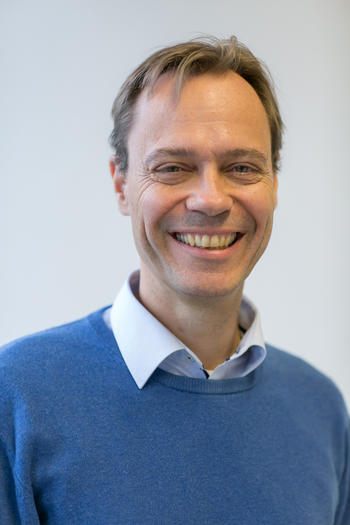
Prof. Dr. Christian Freund
Group Leader
Biochemistry
Group Leader
Protein Biochemistry
Since 2011, Christian Freund is a full professor (W2) of Biochemistry at Freie Universität Berlin, heading the Laboratory of Protein Biochemistry. His research focuses on the molecular mechanisms of antigen processing and presentation by MHC class II molecules and on scaffolding proteins that coordinate intracellular signaling in T cells. His group uses protein engineering, NMR spectroscopy, and structural and biochemical approaches to dissect how protein interactions shape adaptive immune responses.
The research of the Freund Group is supported by competitive national funding sources. Key support includes the DFG Collaborative Research Centre TRR 186 and an Einstein Visiting Fellowship, which strengthens the collaboration between Freie Universität Berlin and partners in the Bay Area. Within TRR 186, the group is embedded in a Heidelberg–Berlin network that brings together universities, Max Planck and Helmholtz institutes and the DKFZ, providing a strong collaborative framework for studying protein dynamics and immune regulation across sites.
University training and degree
1986 - 1989 - Chemistry, Ludwig-Maximilians-Universität München
1983 - 1986 - Chemistry, Heinrich-Heine-Universität Düsseldorf
Advanced academic qualifications
2005 - Habilitation (venia legendi), Biochemistry, Freie Universität Berlin
1994 - PhD, Max-Planck-Institute of Biochemistry, AG NMR (Holak), Department of Structural Biology (Huber)
Postgraduate professional career
2018 (Jan-March) - Visiting scholar at the University of California San Francisco
2011 - present - Full professor of Biochemistry (W2), FU Berlin
2000 - 2011 - Independent research group leader, Leibniz-Institute of Molecular Pharmacology, Berlin
1997 - 2000 - Joint appointment post-doctoral fellow at Harvard Medical School/Dana- Farber-Cancer Institute in Boston with Prof. Gerhard Wagner and Prof. E. Reinherz (Scholarship by the Swiss National Funds).
1994 - 1997 - Postdoctoral fellow in the group of Prof. Dr. A. Plückthun, Biochemical Institute of the University of Zürich/Switzerland.
Prof. Christian Freund and his group are actively involved in teaching at Freie Universität Berlin. Their courses include Biochemie III (Erkennung, Transport und Modifikation von Proteinen), Fortgeschrittene Biochemie – Teil 1 (Nukleinsäuren und Proteine), and practical classes on nucleic acids, proteins, and enzyme kinetics. They also supervise seminars and laboratory practicals and coordinate a Research Practical on research design and grant writing, supporting students in developing the skills needed for independent scientific work.
Recent publications
- Abualrous, E. T., Stolzenberg, S., Sticht, J., Wieczorek, M., Roske, Y., Günther, M., Dähn, S., Boesen, B. B., Calvo, M. M., Biese, C., Kuppler, F., Medina-García, Á., Álvaro-Benito, M., Höfer, T., Noé, F. & Freund, C. MHC-II dynamics are maintained in HLA-DR allotypes to ensure catalyzed peptide exchange. Nature Chemical Biology 19, 1196-1204 (2023). https://doi.org/10.1038/s41589-023-01316-3
- Lan, H., Abualrous, E. T., Sticht, J., Fernandez, L. M. A., Werk, T., Weise, C., Ballaschk, M., Schmieder, P., Loll, B. & Freund, C. Exchange catalysis by tapasin exploits conserved and allele-specific features of MHC-I molecules. Nature Communications 12, 4236 (2021). https://doi.org/10.1038/s41467-021-24401-4
- Vardar, G., Gerth, F., Schmitt, X. J., Rautenstrauch, P., Trimbuch, T., Schubert, J., Lerche, H., Rosenmund, C. & Freund, C. Epilepsy-causing STX1B mutations translate altered protein functions into distinct phenotypes in mouse neurons. Brain 143, 2119-2138 (2020). https://doi.org/10.1093/brain/awaa151
- Morrison, E., Wegner, T., Zucchetti, A. E., Álvaro-Benito, M., Zheng, A., Kliche, S., Krause, E., Brügger, B., Hivroz, C. & Freund, C. Dynamic palmitoylation events following T-cell receptor signaling. Communications Biology 3, 368 (2020). https://doi.org/10.1038/s42003-020-1063-5
- Álvaro-Benito, M., Morrison, E., Ebner, F., Abualrous, E. T., Urbicht, M., Wieczorek, M. & Freund, C. Distinct editing functions of natural HLA-DM allotypes impact antigen presentation and CD4+ T cell activation. Cellular & Molecular Immunology 17, 133-142 (2020). https://doi.org/10.1038/s41423-018-0181-1
- Gerth, F., Jäpel, M., Pechstein, A., Kochlamazashvili, G., Lehmann, M., Puchkov, D., Onofri, F., Benfenati, F., Nikonenko, A. G., Fredrich, K., Shupliakov, O., Maritzen, T., Freund, C. & Haucke, V. Intersectin associates with synapsin and regulates its nanoscale localization and function. Proceedings of the National Academy of Sciences 114, 12057-12062 (2017). https://doi.org/10.1073/pnas.1715341114
- Henning, L. M., Santos, K. F., Sticht, J., Jehle, S., Lee, C.-T., Wittwer, M., Urlaub, H., Stelzl, U., Wahl, M. C. & Freund, C. A new role for FBP21 as regulator of Brr2 helicase activity. Nucleic Acids Research 45, 7922-7937 (2017). https://doi.org/10.1093/nar/gkx535
- Wieczorek, M., Sticht, J., Stolzenberg, S., Günther, S., Wehmeyer, C., El Habre, Z., Álvaro-Benito, M., Noé, F. & Freund, C. MHC class II complexes sample intermediate states along the peptide exchange pathway. Nature Communications 7, 13224 (2016). https://doi.org/10.1038/ncomms13224
- Kuropka, B., Witte, A., Sticht, J., Waldt, N., Majkut, P., Hackenberger, C. P. R., Schraven, B., Krause, E., Kliche, S. & Freund, C. Analysis of Phosphorylation-dependent Protein Interactions of Adhesion and Degranulation Promoting Adaptor Protein (ADAP) Reveals Novel Interaction Partners Required for Chemokine-directed T cell Migration*. Molecular & Cellular Proteomics 14, 2961-2972 (2015). https://doi.org/10.1074/mcp.M115.048249
- Günther, S., Schlundt, A., Sticht, J., Roske, Y., Heinemann, U., Wiesmüller, K.-H., Jung, G., Falk, K., Rötzschke, O. & Freund, C. Bidirectional binding of invariant chain peptides to an MHC class II molecule. Proceedings of the National Academy of Sciences 107, 22219-22224 (2010). https://doi.org/10.1073/pnas.1014708107
Keywords
- MHCII, HLA-DM, HLA-DO,antigen processing, T cell signaling , scaffolding protein, protein–protein interactions, NMR spectroscopy, structural biology